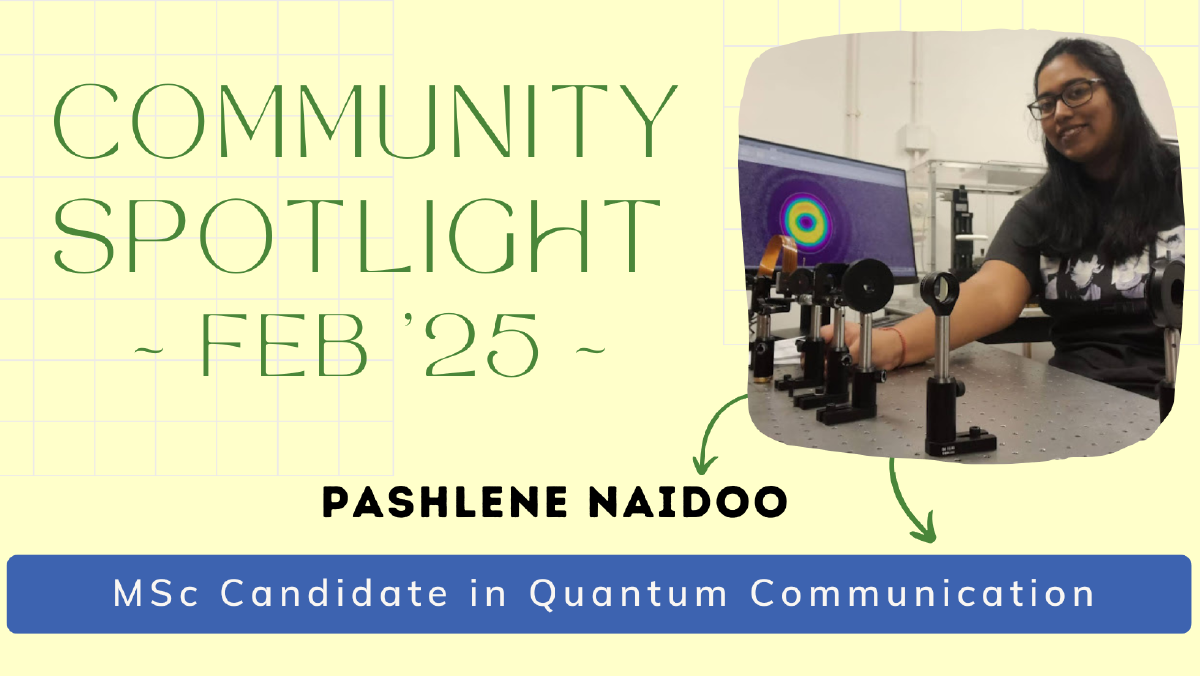
Our February spotlight shines on Pashlene Naidoo from South Africa — a MSc Candidate in Quantum Communication at Stellenbosch University who works with lasers, codes in Python, and is passionate about bringing quantum technology to Africa.
About Pashlene
🎵 What is your favourite song?
📚 Can you describe your background and your current role?
I studied Applied Physics at the University of KwaZulu-Natal (UKZN) for both my undergraduate and honours degrees. My honours project focused on modelling the quantum noise of IBMQ Transmon Qubits using Hierarchical Equations of Motion (HEOM).
I’m currently pursuing my MSc in Physics at Stellenbosch University, researching the encoding of high-dimensional states for Quantum Communication.
In my current role as MSc Candidate, I am a lab rat that works with lasers, studying the effects of spatial coherence on optical beams with the intent of producing optical fields that are less affected by atmospheric turbulence.
Work & Research
💼 Describe a typical workday — how much time do you spend coding?
About 6+ hours in the lab and 4+ hours coding (that’s if there are no bugs) on most days.
Beyond my main research, I give back to the community in several ways: teaching assistant to first-year physics students at Stellenbosch University; Treasurer and Social Media Manager of the Stellenbosch Student Laser Chapter, which organises outreach to Western Cape high schools; volunteer in the STEM MentHer program supporting Grade 12 female students in STEM; and volunteer in the NITheCS micro-school series delivering peer-to-peer skills talks.
Keywords: Quantum · Lasers · Polarisers · Python · Filters · Machine Learning · Content Creator
🏫 Tell us more about your organisation.
🖥️ Tell us about your research software development.
Languages: Python, with NumPy, OpenCV, TensorFlow/PyTorch, and Matplotlib for data processing, image analysis, and machine learning.
What it does: The software processes vortex beam images, extracts polarisation and intensity information, and applies a convolutional neural network (CNN) to predict the topological charge of the beams. I develop it independently, tailored to my specific research needs.
It has been a rewarding experience — strengthening my programming skills and improving my ability to bridge theory and experiment. Working with real experimental data has given me a deep appreciation for the challenges of noise, data preprocessing, and model optimisation in machine learning.
Community & Reflection
💡 Where do you get training and support?
I am part of several communities:
- Stellenbosch Institute of Photonics & Quantum Research Group — weekly meetings to share ideas and assist with research challenges
- Stellenbosch Student Laser Chapter — part of the SPIE and Optica international networks, offering workshops, talks, and networking
- NITheCS — workshops, seminars, and funding for theoretical and computational science
- South African Quantum Technology Initiative (SAQuTI) — national collaboration and funding in quantum technology
The guidance and advice from my supervisor has been invaluable.
💭 How do you see yourself professionally?
🚧 What barriers do you face in your work?
❤️ What part of your job do you enjoy most?
🆘 What would make things easier for you?
🔭 What are you looking forward to this year?
💬 What career advice would you share with other Africans in similar roles?