RSSE Africa has established a new Leadership Team to strengthen coordination, share responsibility for the community’s development, and explore how its work can be sustained over the longer term.
The team brings together professionals working across research software engineering, bioinformatics, high-performance computing, digital research infrastructure, open science, climate research, astronomy, digital language resources, community development, and institutional research support.
Over the years, RSSE Africa has worked to build a community spanning the African continent. This has created valuable connections between people working with research software in different countries, disciplines, institutions, and professional roles.
However, trying to maintain activities across such a large and diverse region with limited voluntary capacity has also spread the community’s efforts too thinly. Many connections have been built through individual events or short-term projects, but have been difficult to sustain afterwards. As a result, members have often remained isolated from one another despite facing similar technical, institutional, and professional challenges.
The new Leadership Team represents a change in approach. Its inaugural members are based in South Africa, making it easier for them to meet, coordinate, and share responsibility consistently. At the same time, their work, networks, collaborations, and projects connect them with research software practitioners and research infrastructure communities across Africa.
The aim is not to narrow RSSE Africa’s focus to South Africa, but to initially establish a stronger base from which relationships across the continent can be developed and sustained.
“RSSE Africa has created many valuable connections, but keeping a community going requires more than goodwill,” said Anelda van der Walt, Strategic Lead and Senior eResearch Analyst at the University of Cape Town. “The Leadership Team gives us a structure for sharing the work, maintaining continuity, reaching new audiences, staying close to what people across the community need, and planning for the longer term.”
Until now, much of RSSE Africa’s coordination and continuity has depended on a small number of people contributing time alongside their existing roles. The Leadership Team creates a broader base for planning, relationship-building, fundraising, community activities, and decisions about what RSSE Africa can realistically take forward.
First in-person meeting#
The Leadership Team met in person for the first time in Cape Town on 10 July 2026.
The meeting focused on the contribution RSSE Africa wants to make, the opportunities and constraints facing the community, priorities for the next six months, and how members will work together.
It also gave the team an opportunity to consider the wider systems in which research software is created, maintained, supported, and used.
“Research software developers across Africa are still largely invisible, even though their work is embedded in the computational and data infrastructures on which modern research depends,” said Peter van Heusden, Strategic Lead and Senior Bioinformatician at the South African National Bioinformatics Institute at the University of the Western Cape. “That is why RSSE Africa is concerned not only with research software, but with the wider systems in which it is developed, maintained, supported, and used.”
The Leadership Team#
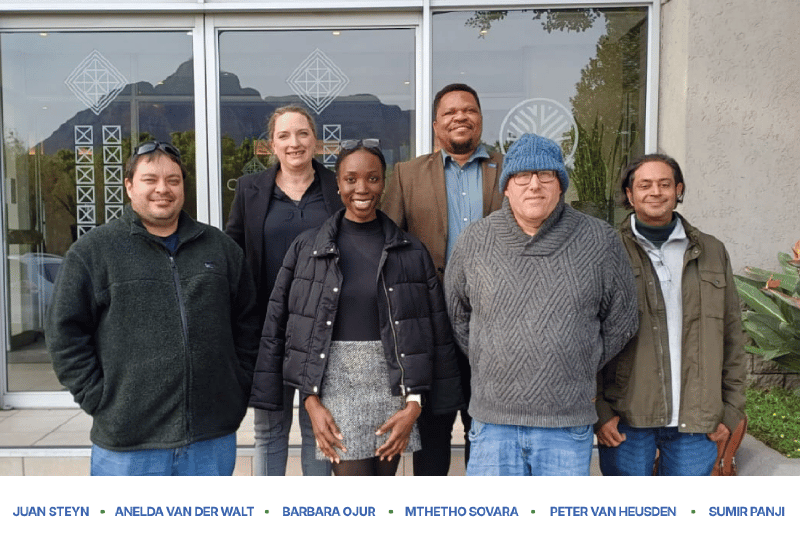
Members were invited to join the Leadership Team based on their past and current work with RSSE Africa, their range of connections across disciplines and institutions, their experience as researchers who write code and/or support research infrastructure, and their commitment to the African research software and systems community.
The Leadership Team comprises:
- Anelda van der Walt, Strategic Lead — Senior eResearch Analyst, University of Cape Town; Director, Talarify
- Peter van Heusden, Strategic Lead — Senior Bioinformatician, South African National Bioinformatics Institute (SANBI), University of the Western Cape
- Barbara Ojur — Software Engineer, South African Radio Astronomy Observatory (NRF-SARAO)
- Juan Steyn — Director of Operations, South African Centre for Digital Language Resources (SADiLaR)
- Mthetho Sovara — Senior Research Engineer, Centre for High Performance Computing (CHPC/CSIR)
- Sumir Panji — Programme Manager, eLwazi Open Data Science Platform
Together, the members bring different perspectives on the technical, institutional, and community dimensions of research software and systems.
“Research software engineers across Africa often work in isolation, even when they are facing many of the same technical and institutional challenges,” said Barbara Ojur. “RSSE Africa can help connect them so that they can share knowledge, learn from one another, and develop and promote good practices that work in our contexts.”
For Juan Steyn, the sustainability of research infrastructure depends on more than the underlying technology.
“Infrastructure is not only about technology,” he said. “It also depends on people, coordination, institutions, and long-term commitment. RSSE Africa can help create stronger connections across those areas.”
The team also brings expertise in high-performance computing, research engineering, and open data science.
“Researchers need access to computing infrastructure, but they also need the software and skills required to use it effectively,” said Mthetho Sovara. “I hope the Leadership Team can help strengthen the links between infrastructure providers, software practitioners, and research communities.”
Sumir Panji emphasised the importance of the communities that form around digital platforms.
“Platforms are useful, but they only have impact when people can use them, contribute to them, and learn from one another,” he said. “RSSE Africa can help build those connections across institutions and countries.”
Next steps#
Over the next six months, the Leadership Team will develop its ways of working, agree on a manageable set of priorities, and identify where RSSE Africa can make the most useful contribution.
The team will also consider how wider community participation can be supported over time. Additional members may be invited in future to broaden the team’s expertise, geographic perspectives, institutional links, and capacity.
The Leadership Team is intended to support, rather than replace, the knowledge, initiative, and participation of the wider RSSE Africa community.
The meeting on 10 July marked the beginning of this next phase of RSSE Africa’s work.